Invasive plants on a development site are a programme risk. Giant Hogweed, Himalayan Balsam and Japanese Knotweed are all classified as controlled waste, their presence requires specialist management before ground works and development can proceed. Horsetail is a very invasive plant but is not classed as controlled waste. Zirkon provides invasive plant surveys, herbicide treatment programmes, and full excavation and licensed disposal services for construction companies, developers, local authorities, land managers, water and rail sectors throughout the UK.


Invasive Plants on a Development Site Are a Programme Risk
Invasive plant species identified on or adjacent to a development site must be addressed before groundworks can commence. Contaminated soils containing invasive plant material are legally classified as Controlled Waste under the Environmental Protection Act 1990 and cannot be excavated and disposed of as standard spoil. Failure to manage invasive plants correctly can result in programme delays, planning complications, and significant additional cost. Commissioning a specialist survey at an early stage allows budgets to be set accurately and remediation to be programmed ahead of groundworks.

Japanese Knotweed
Controlled waste designation affects planning, groundwork programmes, and development timelines. Requires specialist management and a 10 Year IBG on completion.

Giant Hogweed
Hazardous. Sap causes severe chemical burns on contact with sunlight. Classified as controlled waste requiring licensed specialists and full PPE. Can be treated using herbicides or excavation of seed bank.

Himalayan Balsam
Rapid-spreading annual common on disturbed ground and watercourses. Outcompetes native vegetation and increases erosion risk on development sites. Can be treated using herbicides or excavation of the seed bank.

Horsetail (Equisetum)
Deep-rooted prehistoric rhizome system, highly resilient. Requires targeted herbicide management or full excavation to eradicate.
Invasive Plant Surveys
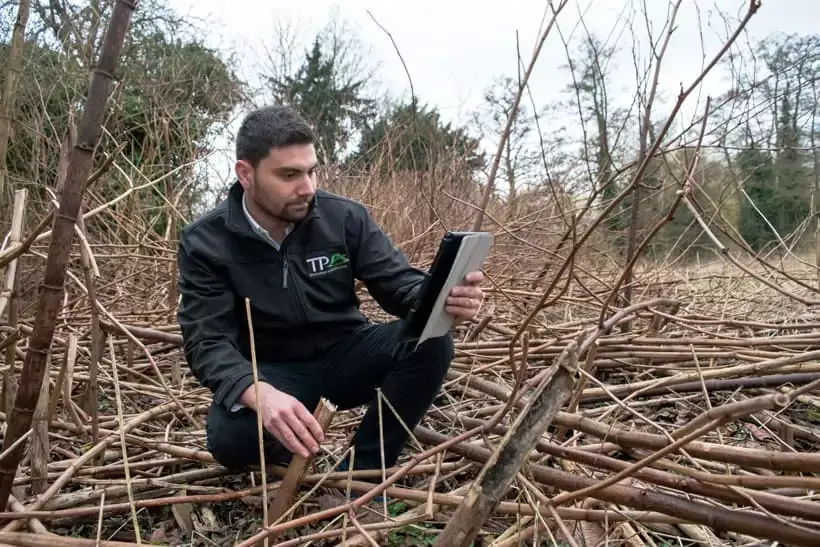
Our specialist surveyors carry out comprehensive invasive plant surveys on commercial and development sites of all sizes. A survey is recommended at the earliest stage of a scheme, identifying species and mapping the extent of any infestation before groundworks are programmed allows remediation costs to be accurately budgeted and avoids programme delays later. Following the site visit, a full written report is produced and a detailed written quotation delivered within 24 hours.
Survey Report Contents
- CAD site plans produced from GIS data recorded on site
- Relevant legislation for each species identified
- RICS risk management category assessment where Japanese Knotweed is present (Residential property only)
- Full site findings and surveyor on-site data sheet
- Annotated site photographs
- Recommended remediation strategy with treatment options costed
Herbicide Management Programmes
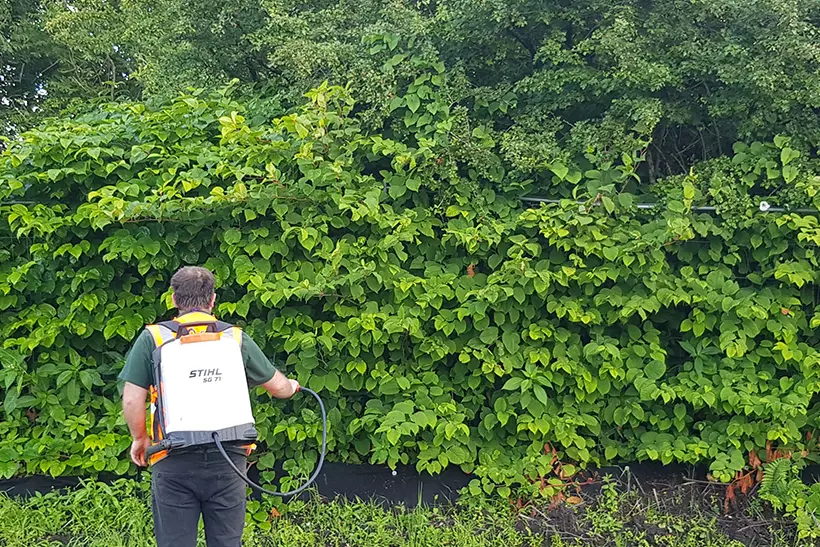
Where development of the affected area is not planned within the programme, a structured herbicide management programme is the most cost-effective remediation route. Our specialists design a treatment plan tailored to the species present and site conditions, applying herbicide at the optimal point in the plant’s growth cycle for maximum effect. Progress is monitored and documented throughout. Depending on the species and severity, a herbicide programme typically spans five growing seasons.

Strategic Advice
Early-stage ecological advice to identify constraints, assess viability, and shape the design of a development scheme before surveys are commissioned.

Faunal Surveys
Surveys for protected and notable species including bats, great crested newts, badgers, nesting birds, water voles, otters, and reptiles.

Ecology Mitigation Schemes
Design and implementation of mitigation and compensation measures to satisfy planning conditions and minimise adverse impact on habitats and species.

Habitat & Botanical Surveys
Phase 1 habitat surveys, extended Phase 1 surveys, and National Vegetation Classification (NVC) surveys to characterise habitats across the site.

Environmental Impact Assessments
Ecological chapters and input to Environmental Impact Assessments (EIA) for major development schemes requiring an Environmental Statement.

Practical Mitigation Works
On-site implementation including great crested newt fencing, badger sett closures and artificial sett creation, and habitat creation and translocation.
Excavation & Licensed Disposal
Where the development programme requires ground within an affected area to be disturbed or developed, physical excavation and licensed off-site disposal is the correct approach. Invasive plant material and contaminated soils are classified as Controlled Waste under the Environmental Protection Act 1990 and must be transported and disposed of at a licensed facility. Our team manages the full process, from excavation through to licensed haulage and disposal, ensuring the site is compliant before groundworks proceed. On completion, a 10-Year Insurance Backed Guarantee is issued (Japanese Knotweed only). Sites are then monitored bi-annually for two growing seasons to confirm no regrowth.
Typical Programme
Most excavations are completed within one to two weeks depending on scale. Development can proceed immediately following completion of our on-site removal works.
Additional Methods
- On-site soil screening (Japanese Knotweed only)
- Cell burial, engineered on-site containment (Site Specific)
- Relocation and treatment within the site boundary
- Root barrier installation
Who We Work With
We work with clients across the construction, development, and land management sectors throughout the UK. Whatever the scale of the project, our team has the experience and accreditations to deliver.
Construction companies
Pre-groundworks surveys to clear the programme

Property developers
pre-acquisition due diligence and pre-planning surveys
Local authorities & councils
Surveys across public land, highways, and housing estates
Property managers
ongoing monitoring and survey programmes for portfolio sites
Industrial & retail estates
site surveys ahead of redevelopment or sale
Infrastructure & utilities
corridor and boundary surveys for linear schemes
Accreditations & Experience

PCA Approved
Members of the Property Care Association, listed as experts in the control and removal of invasive species

10-Year Insurance Backed Guarantee
Available on all remediation work following a survey (Japanese Knotweed Only)

CSJK Qualified surveyors
All site surveys carried out by trained, certified specialists

Established since 2011
Over a decade of commercial invasive plant survey experience across the UK
Frequently Asked Questions
Invasive plants are not automatically required to be declared in a planning application, but their presence on or adjacent to a development site will affect groundwork programming and disposal requirements. Local planning authorities may include invasive plant management conditions in a planning permission. Commissioning a specialist survey at an early stage allows this to be addressed proactively.
Under the Environmental Protection Act 1990 and associated waste regulations, soil contaminated with invasive plant material, particularly Japanese Knotweed rhizome, is classified as Controlled Waste. It cannot be removed from site and disposed of as standard spoil. It must be transported by a licensed carrier and deposited at a licensed facility, with appropriate documentation. Our team manages this process in full.
We offer same-day written quotations following a site survey. Our team can mobilise quickly to sites across the UK. Exact lead times depend on the scale of the works and current programme, contact us to discuss your project timeline.
Yes. We are experienced in working within the constraints of live development sites, including adherence to site-specific health and safety requirements, method statements, and risk assessments. We can coordinate our programme around existing groundworks and other trades.
On completion, we issue a 10-Year Insurance Backed Guarantee (Japanese Knotweed Only). Sites are monitored bi-annually for two growing seasons to confirm no regrowth. All documentation, including waste transfer notes and the IBG, is provided for your records and any planning authority requirements.
Yes. We carry out invasive plant surveys and remediation works on commercial and development sites across the whole of the UK.
Working on a Site Affected by Invasive Plants?
Get in touch to arrange a site survey and receive a detailed written quotation within 24 hours. We work with construction companies, developers, local authorities, and land managers across the UK.